
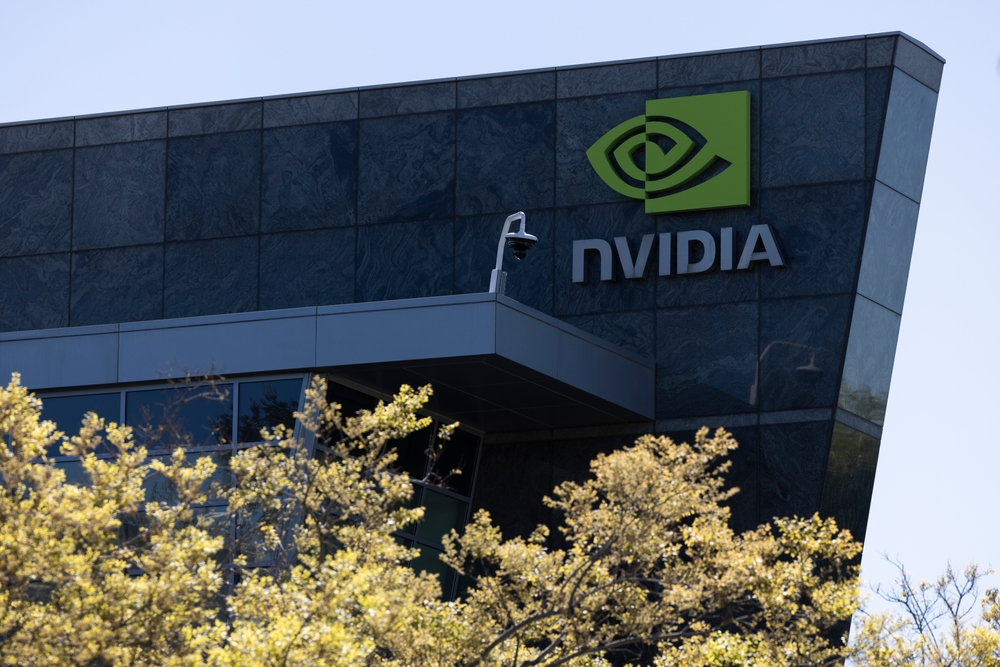
Nvidia did it again.
The world's most valuable company, and the most-watched name in artificial intelligence, blew past Wall Street expectations on Wednesday afternoon, reporting fiscal first-quarter revenue of $81.6 billion — up 85% from a year ago and 20% higher than the prior quarter. The Data Center business, the engine that made Nvidia a multi-trillion-dollar colossus, posted record revenue of $75.2 billion, up 92% year over year.
The numbers comfortably topped analyst forecasts. Bloomberg's consensus had pegged revenue at roughly $79.2 billion and non-GAAP earnings per share at $1.77. Nvidia delivered $1.87 on the bottom line and trounced the top line by more than $2 billion. Data center networking revenue alone reached $14.8 billion, nearly tripling from a year ago — a clear sign that the buildout of AI factories isn't just about GPUs anymore.
The market reaction, after a brief moment of hesitation in late after-hours trading on Wednesday, was the kind of relief rally chipmakers had been waiting for. Nvidia shares jumped roughly 6% on Thursday, sparking a rally across global semiconductor names. Taiwan Semiconductor, AMD and Qualcomm each climbed about 1%, extending a chip-sector advance that has already made the PHLX Semiconductor Index one of the standout stories of 2026, surging more than 65% year to date.
For investors who had grown nervous heading into the print, the report was both validation and a sigh of relief. Nvidia shares had slipped 6.4% in the three sessions before the release as inflation jitters weighed on the group. Coming in, the company had beaten expectations in 18 of the last 20 quarters yet still saw its stock fall after each of its three prior earnings releases — including a 5% drop after the February print. This time, the beat was big enough, the guidance bullish enough, and the capital-return news flashy enough to break the pattern.
Speaking of capital returns: Nvidia paired its quarterly numbers with two pieces of news shareholders rarely get on the same day. The board authorized $80 billion in additional share repurchases and increased the quarterly cash dividend from $0.01 per share to $0.25 per share — a 25-fold raise. The new dividend will be paid on June 26 to shareholders of record as of June 4. That is not the move of a company that thinks growth is about to slow; it's the move of a company throwing off so much cash it has to do something with it.
Chief executive Jensen Huang, never one to undersell the moment, framed it in plain terms in the press release: the buildout of AI factories is "the largest infrastructure expansion in human history" — and it is accelerating. He has a point. The four largest hyperscalers — Alphabet, Amazon, Microsoft and Meta — have collectively guided to roughly $725 billion in 2026 capital expenditures, up 77% from last year's $410 billion. Much of that flows directly through Nvidia's order book.
Guidance was the other piece investors zeroed in on. For the second quarter of fiscal 2027, Nvidia projected revenue of $91 billion, plus or minus 2%, with gross margins around 74.9% on a GAAP basis and 75.0% on a non-GAAP basis. Notably, the outlook assumes no Data Center compute revenue from China, leaving room for material upside if export-license dynamics shift later in the year.
Some of the quietly important details came from the earnings call. Nvidia disclosed that revenue from its Vera CPU — from both standalone sales and Rubin bundle configurations — is expected to reach approximately $20 billion this year, which would make Nvidia the world's largest CPU supplier, overtaking AMD and Intel. That is a flag planted directly on the competition's home turf. The market had not modeled this number in any meaningful way, which is part of why several analysts spent Thursday morning revising estimates higher.
The setup heading into Wednesday had been unusually fraught. Options markets were implying a 5% to 7% move, and short interest in adjacent names like Qualcomm had ballooned to roughly $11.8 billion on a notional basis — the highest level in at least a decade, according to S3 Partners. That positioning has been forced to reset in real time. Hedge funds that were leaning bearish have had to cover, and the broader chip rally has picked up another tailwind.
Not every reaction has been unambiguously celebratory. A handful of strategists pointed out that the valuation had already priced in something close to perfection, and that even a record-shattering print of this magnitude was only modestly above consensus on a percentage basis — a revenue beat of roughly 1.5%, and an EPS beat north of 4%. "Nvidia is no longer beating a high bar — it is the bar," William Rhind, CEO of GraniteShares, told Al Jazeera, adding that expectations had caught up to fundamentals.
There is also the longer-term question of customer concentration and the rise of in-house silicon from the same hyperscalers writing Nvidia its checks. Google, Meta and Microsoft are investing heavily in developing their own chips, and new entrants are well-funded — AI chipmaker Cerebras Systems recently completed a $5.55 billion IPO. For now, though, the picture is one of insatiable demand at the high end, where Nvidia's Blackwell platform — and the upcoming Vera Rubin systems — sit essentially alone.
The verdict on Wall Street, at least for now, is straightforward. Nvidia remains the biggest stock in the market and has accounted for almost a fifth of the S&P 500's advance this year, with Micron, Broadcom, AMD and Intel rounding out an unusually chip-heavy leadership group. The rally that has powered so much of 2026 just got a fresh fundamental catalyst. And the AI capex cycle, which skeptics keep insisting must be near its peak, just earned another extension on the lease.
For Jensen Huang's empire, the bar has been reset — higher.